
What Happens When America’s Power Grid Becomes a Last Resort?
Good news. Electric grid reliability was a lot better in 2025 than in 2024. But one swallow does not make a spring, as Aristotle noted, a number of years ago. Grid reliability, we believe, has been trending downward since the turn of the century, that is, since deregulation really got rolling. Okay, you could argue, as a good logician, that this is an example of a post hoc ergo propter hoc fallacy, that is, because event B took place after event A must mean that A caused B. We admit that. We’re just pointing out the chronology, before applying a few lessons from Wall Street.
First, to the numbers graphed below. The blue line is based on outage numbers issued by the Energy Information Administration, a series that ended in 2023. Note the upward trend. The green line shows outage minutes per average customer, as calculated by the Institute of Electrical and Electronics Engineers (IEEE). It shows a wide-ranging variability from year to year, but on an upward trend. The grey line, trending upward slightly but relatively smooth, shows average outages after excluding Major Event Days; in other words, reliability when there is nothing big going on to affect reliability.
Let’s consider these numbers from a Wall Street perspective. First, the reliability number excluding Major Event Days looks suspiciously like “adjusted earnings”, the procedure whereby management removes unusual and supposedly one-time items from the income statement they report to Wall Street. (They have to report those items in the audited statements, but they like to divert attention to the adjusted numbers.) “Hey, this is a one-time event; it won’t happen again, so ignore it.” Instead, something else happens next year, and on and on. We could say the same about hurricanes. Each one is a unique event, but they keep recurring. Customers want to know how good you are at keeping the lights on during challenging moments, not when all is calm.
Second, look at the volatility of the outage numbers. As any finance 101 student will tell you, the greater the volatility, the greater the risk. In this case, we mean risk to users of the grid, who have to decide whether to invest in storage or a supplemental power source to protect against grid failure. If batteries cost you $2000 per year to protect against that two-hour average outage, you might decide not to buy the protection. If you are running a business that needs ultra-reliable power, you might invest if a six-hour outage were likely but not a two-hour outage. Do you risk the outage or the overinvestment in storage?
Let’s look at the issue from some other angles. First, because of solar plus storage, there is an urban-rural cost divide re-emerging in the electric power business, something we haven’t seen since the 1930s. It was always understood that rural customers were far more expensive to serve than urban ones. The financial return on a mile of utility distribution line in, say, Manhattan, NY, with perhaps 25,000 customers per mile is far greater than the return on distribution assets in Manhattan, Kansas, with perhaps five customers per mile. But now, financially, it is cheaper (and technologically feasible) for the monopoly utility service provider to cut these high-cost customers off from the grid and offer them standalone solar, batteries, and propane backup generators. In other words, the old problem of serving high-cost utility customers in remote areas never went away, but now it can be addressed in a very different manner which is cheaper for the utility overall and provides better reliability for the customer.
As if to make our case, a new entrant in the battery market recently raised money. It installs relatively large batteries in homes at no expense to the homeowner, and in an outage it provides about 36 hours of power. Aside from opportunities for simple arbitrage, since we’re talking about finance here, these are simply arbitrage machines. (They may discharge or provide electricity at times of high power prices and recharge themselves when power prices are low), They also may be able to take advantage of other profit-making opportunities created by the state of the grid. Residential customers get some cheaper power and outage protection while the corporate owner gets the other profit opportunities. We think this business will grow.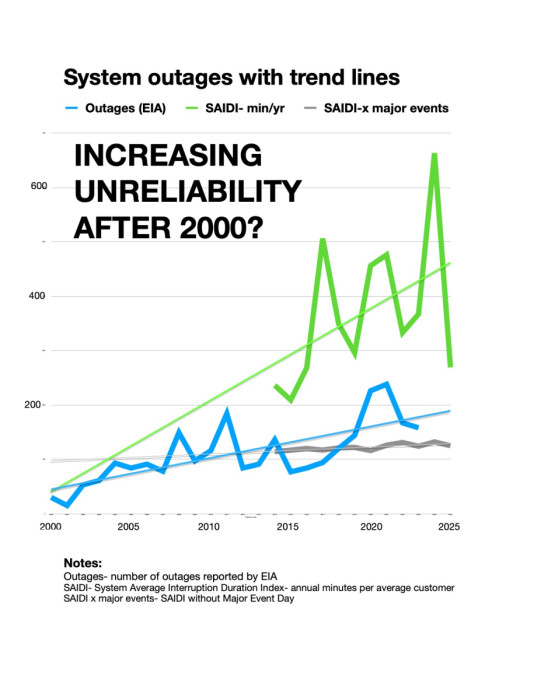
In sum, we don’t offer advice to customers. We suspect, however, that if the grid cannot start to show consistent improvement, given both the declining cost of storage and the difficulty of getting a grid connection, more customers who can will go off the grid, which could reduce the financial support needed to improve its operations. As we have argued before, if big customers reduce use of the grid or desert it altogether, the grid could become a provider of last resort for those who cannot afford to leave it, which will bring up the question of how to support the grid as a public good. Better to improve service and keep customers happy than open that can of worms.
This post appeared first on https://oilprice.com